FORMULAS AND METHODS
Revision sheets
One sheet per topic: definitions, equations and conditions of use.
REVISION SHEET · 01 · 12 SHEETS
Notation and units
A change is written ΔX = Xf − Xi. U, H, Q and W are expressed in joules. A molar enthalpy is expressed in J·mol⁻¹ or kJ·mol⁻¹. The symbol ° denotes standard states; the temperature must still be specified.
| Equation | Application |
|---|---|
| 1 bar = 10⁵ Pa ; 1 L = 10⁻³ m³ | 1 Pa·m³ = 1 J ; 1 bar·L = 100 J |
| 1 kJ = 1 000 J | Express all contributions in the same unit before adding them. |
| T/K = θ/°C + 273.15 | A temperature difference of 1 °C equals 1 K. |
| R = 8.314 J·mol⁻¹·K⁻¹ | Use T in kelvins with R. |
| p° = 1 bar ; c° = 1 mol·L⁻¹ | Standard conventions. |
REVISION SHEET · 02 · 12 SHEETS
Describing a system
Exchanges with the surroundings
Closed: energy, but no matter
Isolated: neither matter nor energy
The definitions concern the exchanges that are possible.
Parameters
: T, p, concentration, mole fraction
An extensive parameter is proportional to the amount of substance. An intensive parameter is independent of it.
Amounts of substance and gases: n = m/M ; m = ρV ; n = cV ; pV = nRT ; xᵢ = nᵢ/ntot ; pᵢ = xᵢp. Extent of reaction: nᵢ = nᵢ,₀ + νᵢξ; for a complete reaction, ξmax is the smallest nᵢ,₀/|νᵢ| among the reactants.
REVISION SHEET · 03 · 12 SHEETS
First law
Energy balance —
Thermodynamic potentialdU = δQ + δW
Balances: closed system, with changes in macroscopic kinetic and potential energy neglected. Energy received is positive; energy released is negative.
REVISION SHEET · 04 · 12 SHEETS
State functions and processes
Integrating an exact differential
U and H are state functions: their changes do not depend on the path. Over a cycle, their changes are zero. Q and W depend on the path: ∫δQ = Q and ∫δW = W.
Processes at a constant parameter
, ideal gas of fixed composition: ΔU = 0 and W = −Q
System properties and exchanges with the surroundings
: Q = W = ΔU = 0
The balance applies to a closed system with pressure–volume work only and negligible changes in macroscopic mechanical energy. A process with no heat transfer is also called adiabatic. A system with adiabatic walls can exchange work; an isolated system cannot.
Cycle: a sequence of processes returning the system to its initial state. The path is closed; ΔUcycle = ΔHcycle = 0 and Qcycle + Wcycle = 0.
REVISION SHEET · 05 · 12 SHEETS
Calculating work
General expression
Work depends on the external pressure. Expansion against a positive pressure gives W < 0; compression gives W > 0.
Monobaric process
If external pressure is constant, it can be taken outside the integral. Isobaric means constant system pressure; constant external pressure is a separate condition.
Ideal gas, fixed amount, reversible isothermal process
We use pext = p = nRT/V in the reversible limit. An isothermal process alone does not justify this substitution. At constant volume, W = 0. At constant pressure with p = pext, W = −nR(Tf − Ti).
REVISION SHEET · 06 · 12 SHEETS
Enthalpy
ΔH = ΔU + Δ(pV)
H is a state function. For a finite change, retain the change in the entire product pV.
Heat at constant pressure
For these balances: pressure–volume work only, constant external pressure, initial and final states at that pressure, and negligible changes in macroscopic energies.
REVISION SHEET · 07 · 12 SHEETS
Heat capacities
C = n Cmolar = m cspecific
System heat capacity: J·K⁻¹; molar: J·mol⁻¹·K⁻¹; specific: J·g⁻¹·K⁻¹ or J·kg⁻¹·K⁻¹. Choose the mass unit matching the given value.
Temperature change without a phase transition
At constant pressure: ΔH = ∑ᵢ nᵢ Cp,m,i (Tf−Ti)
These expressions assume fixed composition, no reaction or phase transition, and constant heat capacities over the interval. For a mixture, sum the contributions of its constituents.
If heat capacity depends on temperature
On peut utiliser cette forme polynomiale ou retenir une capacité constant sur l’intervalle. The table in the mathematics revision sheet can be used to integrate the polynomial.
REVISION SHEET · 08 · 12 SHEETS
Phase changes
Phase transition
Qtotal = ∑ Qheating + ∑ Qphase transition
n is the amount transformed. Use the molar enthalpy of the phase transition at the temperature of this step.
Specific enthalpy of phase transition. L is the same phase-transition enthalpy expressed per unit mass, also called “specific latent heat”. With Δphase transitionH the molar value and M the molar mass, n = m/M gives, at constant pressure with pressure–volume work only:
L = Δphase transitionH / M
m, M and L must use consistent mass units. Lfus and Lvap are positive; for freezing and condensation at the same temperature, Qp = −m L. During the plateau, heat received changes the phase rather than increasing temperature: m c ΔT is not used for this step.
Notation: Δ indicates a change; H denotes enthalpy; subscripts r, f, comb, fus or vap identify the process; ° denotes standard states; T is temperature in kelvins. ΔH is in J; ΔrH is in J·mol⁻¹.
REVISION SHEET · 09 · 12 SHEETS
Reaction enthalpies
Definition and extent of reaction
ΔH ≈ ξ ΔrH°
For the reaction contribution at constant temperature and pressure. This expression assumes zero initial extent and a reaction enthalpy approximated by a constant standard value. In the Ellingham approximation, ΔrH° is treated as constant over the temperature interval.
Dissociation, ionisation, electron attachment
M(g) → M⁺(g) + e⁻ : ΔionH° > 0
M(g) + e⁻ → M⁻(g) : ΔAEH°
For bond formation from gaseous atoms, use the negative of the bond dissociation enthalpy.
Phases: species can cancel in a sum of equations only if they have the same formula and physical state. If needed, add phase-transition or dissolution enthalpies. Dissolution A(s) → A(aq) differs from gaseous bond dissociation.
Elemental substance: contains only one chemical element, for example H₂, O₂ or C(graphite). A compound contains several elements. Formation produces one mole of compound from the reference elemental substances.
Combustion : H₂O(l) unless otherwise stated in this pathway. Molar combustion enthalpy refers to one mole of fuel; the water phase must match the data used. Bond enthalpies concern gaseous species, separating the bond contribution from intermolecular interactions.
Dissolution of an ionic solid: lattice dissociation and ion solvation; in water, hydration. Dissolving a molecular compound does not necessarily form ions.
REVISION SHEET · 10 · 12 SHEETS
Hess cycles
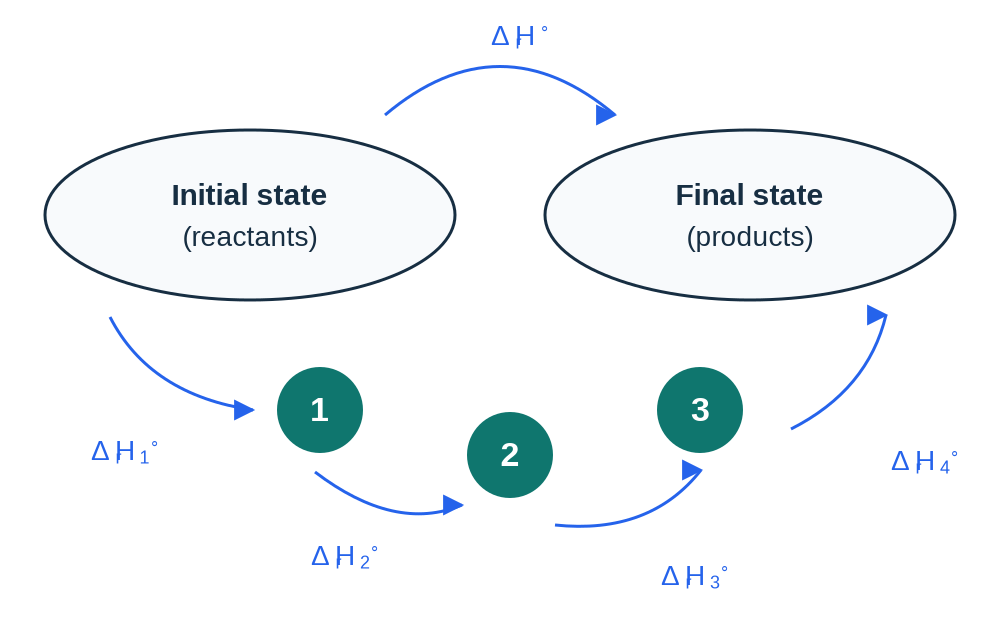
Using formation enthalpies
The coefficients in both sums are the positive coefficients of the balanced equation. The phases and temperature of the data must match the reaction. ΔfH° is zero for an element in its standard reference state.
Relationship between ΔrH° and ΔrU° for bomb calorimetry
Combining reactions
Reversing a reaction changes the sign of its enthalpy. Multiplying an equation by k multiplies its enthalpy by k. Adding the equations must give the target reaction.
REVISION SHEET · 11 · 12 SHEETS
Calorimetric energy balances
Sum of contributions
Qcalo + Qheating + Qphase transition + Qreaction = 0
An adiabatic calorimetric assembly at constant pressure in this model. Include only the processes that actually occur. The constituents may exchange heat with one another.
Calibration using two water samples
The calorimeter and cold water start at T₁; the hot water starts at T₂. Rearrange this equation to obtain Ccalo.
Heat of reaction
Calculate each temperature change separately. In the Zn/Cu²⁺ exercise, the sum includes the calorimeter, solution and zinc.
Partial or complete melting
Ice at 0 °C, water and calorimeter initially at Tᵢ > 0 °C: compare (Ccal + mwatercwater)Tᵢ with miceLfus. If the first value is smaller, Tf = 0 °C and mmelted = Qavailable/Lfus. Otherwise all the ice melts; add the heating of the resulting water if Tf > 0 °C.
Molar values: at constant pressure, ΔrH ≈ Qreaction/ξ; at constant volume with pressure–volume work only, ΔrU ≈ QV, reaction/ξ. The sign is that of the heat received by the reacting system.
REVISION SHEET · 12 · 12 SHEETS
Mathematical guide: antiderivatives and integrals
The integral adds contributions over an interval. Rectangles provide an approximation. If F′ = f, an antiderivative gives the exact calculation:
| Function | Antiderivative, up to an additive constant |
|---|---|
| k constant | kx |
| xᵃ, a ≠ −1 | xᵃ⁺¹/(a+1) |
| 1/x, for x > 0 | ln(x) |
| a + bx + cx² | ax + bx²/2 + cx³/3 |
Reversing the bounds changes the sign of the integral. Finding an antiderivative of pext(V) for a given path does not make W a state function: the pext(V) curve can change with the path.
Return to the interactive rectangle illustrationThermochemistry · Lénaïc Lartigue · Practical reference · CC BY-NC-ND 4.0